TL;DR
- Paid WiFi works best as a premium tier on top of a free tier that actually works, not as a gate in front of basic access.
- Venues with long stays and heavy bandwidth use, such as hotels, resorts, RV parks and convention centers, have the strongest case for a paid tier.
- Short-visit venues like shopping centers, restaurants and airports usually earn more from free WiFi that captures consented guest data than from charging for access.
- Every paywall in front of basic access reduces the number of guests who log in, which shrinks the first-party data your marketing depends on.
- Aislelabs Connect gives venues a branded captive portal where free, paid and sponsored access options can be presented clearly.
If you’re deciding whether to charge for paid WiFi at your venue, you’re weighing a direct revenue line against something harder to price: guest goodwill and the data you collect when people log in. It’s a hard call because WiFi now sits between a utility and an amenity, and the right answer changes with how long guests stay and what they do online. The good news is that most venues don’t have to choose one or the other. In this guide, you’ll find the five WiFi access models venues use, where charging makes sense and where it backfires, how to price and disclose paid tiers, and how to protect your guest data while you do it.
What Paid WiFi Means for a Venue
Paid WiFi is any setup where a guest pays for internet access, either for basic access or for an upgraded tier with more speed, time or devices. The captive portal is the gate, and the payment unlocks the session.
The distinction that matters most is between charging for access and charging for an upgrade. With a time based upgrade model, everyone gets a usable connection and guests who stay longer at a venue can then can pay for more.
Guest expectations favor the second model. Pew Research Center reports that 91% of US adults own a smartphone (Pew Research Center, October 2026), so almost every visitor arrives expecting to get online.
The Five Guest WiFi Access Models
Venues typically choose between five guest WiFi models: free open access, free access behind a login, tiered free and paid access, fully paid access, and sponsored access. Most successful venues run two or three of these at once.
| Model | How It Works | Best Fit |
| Free and open | No login, no data captured | Rarely the best choice for any venue |
| Free behind a login | Guests sign in with email, SMS or social and give consent | Shopping centers, restaurants, airports, stadiums, coffee shops |
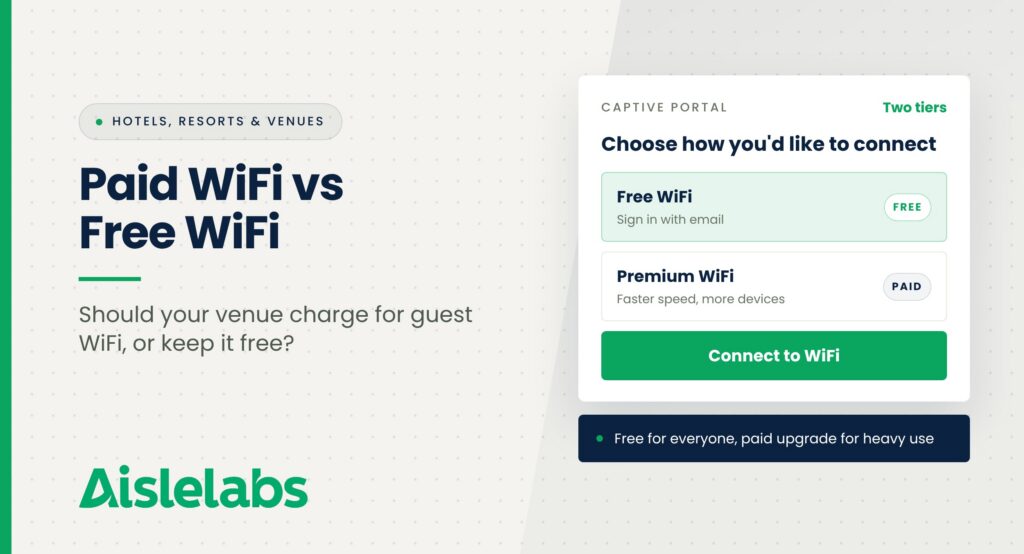
| Tiered free and paid | Usable free tier, paid tier for speed, time or devices | Hotels, resorts, RV parks, convention centers |
| Fully paid | No access until payment | Remote sites with costly backhaul |
| Sponsored | A brand pays for placement on the portal and guests connect free | High-traffic venues with valuable audiences |
Free behind a login is the most underrated model: no direct revenue, but every login can produce a verified contact and consent record. Our guide to sponsored guest WiFi covers the model where brands, not guests, pay for access.
When Charging for WiFi Makes Sense
Charging for WiFi makes sense when guests stay long enough to use heavy bandwidth and the premium tier delivers something the free tier can’t. Length of stay and type of use are the two deciding factors.
Hotels and resorts. Multi-night guests stream, video call and work remotely, often across several devices. A longer tier or higher device limit is a fair upgrade when the standard tier still handles everyday browsing.
RV parks and campgrounds. WiFi now shapes booking decisions here. NBC News reported that about 40% of campers say WiFi availability affects where they camp, rising to 65% among Gen Z and millennials, citing the Outdoor Hospitality Industry (NBC News, 2024). Our RV park WiFi guide covers tier design for parks in detail.
Convention and exhibition centers. Exhibitors need reliable dedicated bandwidth and expect to pay for it, while attendees still need free access.
When Paid WiFi Costs More Than It Earns
Paid WiFi costs more than it earns when visits are short, guests expect free access and the venue’s real value comes from the visitor relationship rather than the connection.
A shopping center or restaurant visitor staying under an hour is unlikely to pay for WiFi, so a paywall earns little. It also stops that visitor logging in, so you lose the email, consent and return visit data you could have captured free.
Airports are similar: a free login tier gives commercial teams a channel to reach travelers about dining, retail and parking, often worth more than a few paid sessions.
There’s also a reputational cost: a free tier throttled to push upgrades tends to show up in reviews as a complaint.
Why Paywalls Shrink Your Guest Data
Every paywall in front of basic access reduces the number of guests who log in, and fewer logins means fewer consented contacts for marketing. That’s the trade-off most paid WiFi business cases leave out.
A login-based free tier captures a verified email or phone number, a consent record and a return visit history, first-party data you own. A paid-only model captures a payment record from a small share of guests, often without marketing consent.
The tiered model keeps both: everyone logs in, so your list keeps growing, while heavy users pay for more. With a WiFi marketing and analytics platform, the free tier becomes the top of your guest database rather than a giveaway.
With Hotspot 2.0 and Passpoint, a guest who signed in once can reconnect automatically on later visits.
From our Hotspot 2.0 release: When we launched Hotspot 2.0 support, a key goal for venues was keeping returning guests connected without a fresh portal sign-in each time, so access can extend from 14 days to up to 365 days.
Paid and Free WiFi With Aislelabs
Aislelabs has three separate products, and which ones fit depends on your venue.
Aislelabs Connect is the fully branded captive portal where your free, paid and sponsored options are presented. It supports multiple authentication methods, including email, SMS, social and room or folio number, captures GDPR, CASL and CCPA compliant consent, supports Hotspot 2.0 and Passpoint, and reports return visits. If you’re planning a paid tier, talk to our team about your payment gateway so we can confirm the right integration approach for your network.
Aislelabs Marketing runs on the guest records Aislelabs Connect captures at the portal, so the guests who log in to your free tier can receive visit-triggered email and SMS, first-visit welcomes and lapsed guest win-back campaigns.
Aislelabs Flow AI fits venues with distinct zones or multiple locations, such as resorts, RV parks, convention centers and airports. It measures footfall and dwell time by zone from your existing access points, which shows where guests spend the most time and helps you plan coverage and amenities around it. For a single-room venue such as a small cafe, zone and heatmap analytics don’t apply, and Connect and Marketing are the right fit.
Request a demo to explore how Aislelabs can transform your business with WiFi marketing and analytics.
FAQs About Paid WiFi
Most venues should keep basic WiFi free and charge only for a premium tier with more speed, time or devices. Charging for basic access works mainly at remote sites with expensive connections.
Tiered WiFi pricing gives every guest a usable free tier and offers a paid upgrade for heavier use. It’s common at hotels, resorts, RV parks and convention centers, where guests stay longer and stream or work online.
Free WiFi behind a login is better for marketing because far more guests sign in, giving you more consented contacts. A paid-only network captures fewer guests and often no marketing consent.
Yes, a captive portal can present a free login tier and a paid upgrade on the same page. Aislelabs Connect provides the branded portal, and our team can confirm the payment integration for your network.
By Zahid Rawat, Senior Marketing Manager at Aislelabs